Reflections on 2025 part 1 - the maiden voyage of Raybel restored
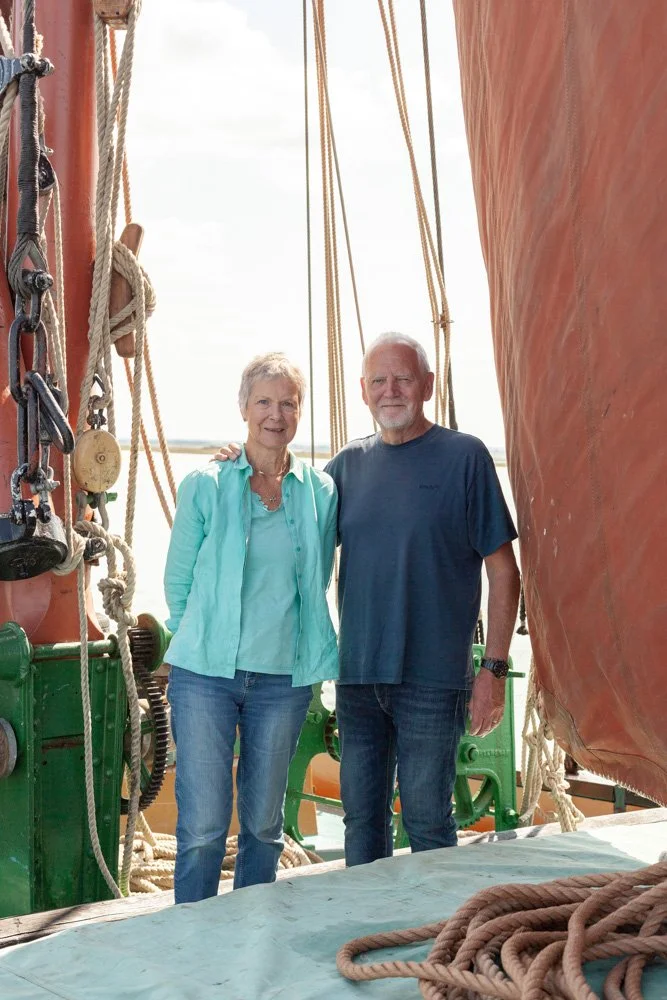
For the first of our reflections on last year, there can be no other place to start than last summer’s return to sail. We invited along people who had supported the restoration over the years - including the Gentle Auther, who has written several blogs about Raybel and sail cargo on his Spitalfields Life site. Here he recounts the day, and a meeting with the decendents of Raybel’s first owners.
——
For the past few years, Contributing Photographer Rachel Ferriman & I have been making regular trips down to the creek at Sittingbourne to follow the restoration of the hundred-year-old Thames sailing barge Raybel from rotting hulk to seaworthy vessel. So it was a highlight of the summer to be invited upon her maiden voyage from Queenborough on the Isle of Sheppey this August.
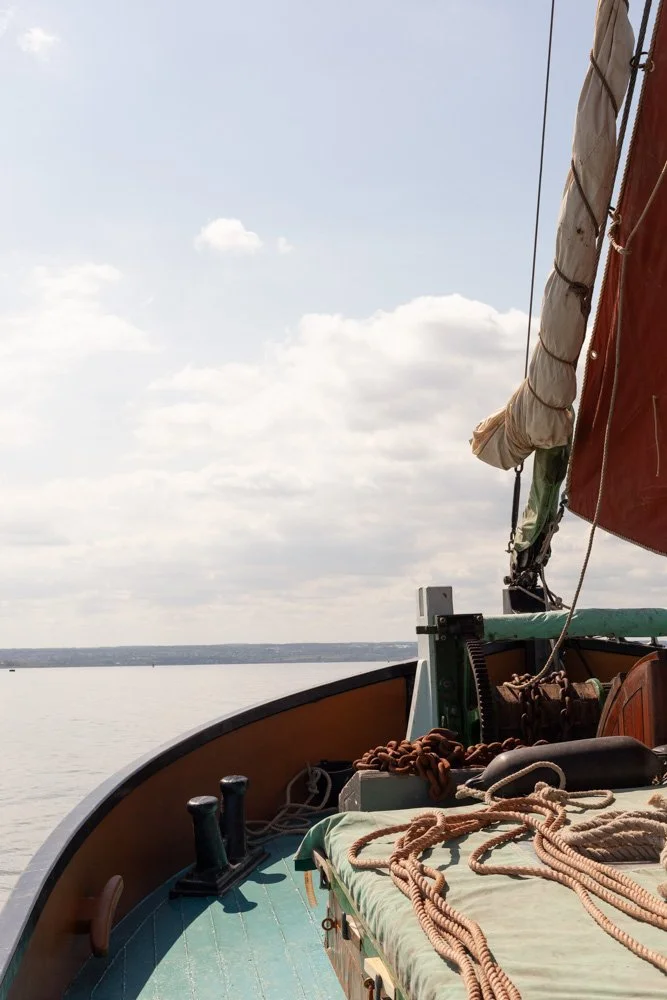
The day was clear but still when we departing the dock, so the engine was employed to take us out into the Medway where the sails were raised and we drifted across the wide estuary. Although there was no visible evidence on that serene summer afternoon, this was where the Dutch fleet attempted to destroy the English Navy with a surprise raid in 1667, leading to more than 600 casualties and the wrecks scattering the river bed here to this day.
On board our auspicious voyage were Professor Jackie Sully and her brother Ron Sully, grandchildren of George Sully who commissioned the building of the Raybel over a century ago. Once the voyage was underway, I sat down in the hold with Jackie and Ron, and Ron told me the story.
‘It was my grandfather George Frederic Sully who commissioned Raybel to be built at Sittingbourne in 1920. He named it after my father Raymond and his twin sister whose middle name was Isabel.
His father was a shipbroker and my grandfather bought sailing barges and went from strength to strength. Back in the day, we had eighteen or twenty barges, we were bigger than Everards. We were based in Fenchurch St near the Minories in the City of London . In those days you had to have an office in London because all the trade was done on the floor of the Corn Exchange. They went one week and spoke to the merchant and arranged the cargo, signed a charter party and the next week they went back and got paid in gold sovereigns. That’s how the trade was done because the London Docks were the terminus for everything coming into this country and the barge distributed cargos up the east coast.
Raybel was made by the shipwright at Sittingbourne, but another yard we used was Cook’s of Maldon. My grandfather had the Raybel built about one foot shorter than the conventional barge, the reason for that was so it could go through Mountford Lock at Lowestoft to get to Norwich up the Haddisco Cut without going through Yarmouth, because the dues in Yarmouth were twice the dues in Lowestoft. So it was cheaper to take a cargo up to Norwich that way.
He was quite a wealthy man, the first man in Chertsey to own a motor car – but he didn’t drive, he had a chauffeur. It was literally riches to rags in three generations!
My father moved the business from London when the Docks died, by then all the trade was up on the east coast so he opened an office in Norwich for about a tenth of the rent he was paying in London. He took the gear out of the sailing barges and put Gardner engines in them, it was quicker and more efficient, and with an engine they could get a lot more freight in and more cargos. The crews in those days were paid their share after their disbursements, it was 50-60% of the freight and the barge owner had the remainder.
The days of sail were over. It wasn’t quick enough and you were at the mercy of the wind and the tide whereas with with a single screw engine you get to places you couldn’t get to under sail. And they built wheelhouses to make the crew more comfortable while they were at sea. They traded up and these barges went across to the near continent, as well as all the little east coast ports, Maldon, Brightlingsea, Colchester, Wivenhoe and further up to Yarmouth and the Wash bay ports, Boston, Wisbech, King’s Lynne, Sutton Bridge, Fossdyke, and up the Humber. We used to go right up to Gainsborough, I don’t think any trade goes up there any more.
My father was born into it. After his wartime service, he came into the office with his brother Bernard. Grandfather died in 1948 and I was born in 1949.
The industry has demised now, we do not have a British merchant fleet anymore. The transition to containerisation was a big part of it along with the end of the London Docks. Distribution by sea was no longer needed and transport shifted to road. Our barges carried everything from animal feedstuffs, to coal, to scrap and ammunition.
The barges became less cost effective to run – our coasters were 600 tonners and we had a couple of bigger ones and a couple of smaller ones – but we could not increase the load. We had a 250 tonner, the Subaventure, she was the last barge to take malting barley to the Snape Maltings. I had an interesting conversation with an old boy who used to be the pilot to take them up to Snape. He used to scull his dinghy down there and put withies in where the water was deep with an upturned baked bean can on the top and he knew when the baked bean can floated off that there was enough water for the barge to come through. It was fine for a day until some kids went down there and shot all the cans off the withies with an airgun.
My father retired aged seventy-five in 2000, there was still a business then but it got more and more difficult as all the small ports were disappearing. I joined the business in my thirties and I was taught by my father. I had ten great years until we ceased trading. It was a great shame.’
Then Ron sat in silence in acknowledgement of the loss, but also in affectionate reverence for the recovery of the Raybel. So Jackie picked up the story and brought us back to the present moment as we sat there in the cool of the hold of the newly renovated barge, drifting on that warm summer afternoon.
‘After Raybel was decommissioned, it was moored in St Katharine’s Dock for many years as an events venue but then it was just left to rot because they weren’t using it. So it is emotional for us, coming back here now it has been renovated, because I remember being on Raybel before. I remember the smell of it, the moment you are on it you can smell it, and it still has the same smell today.’